
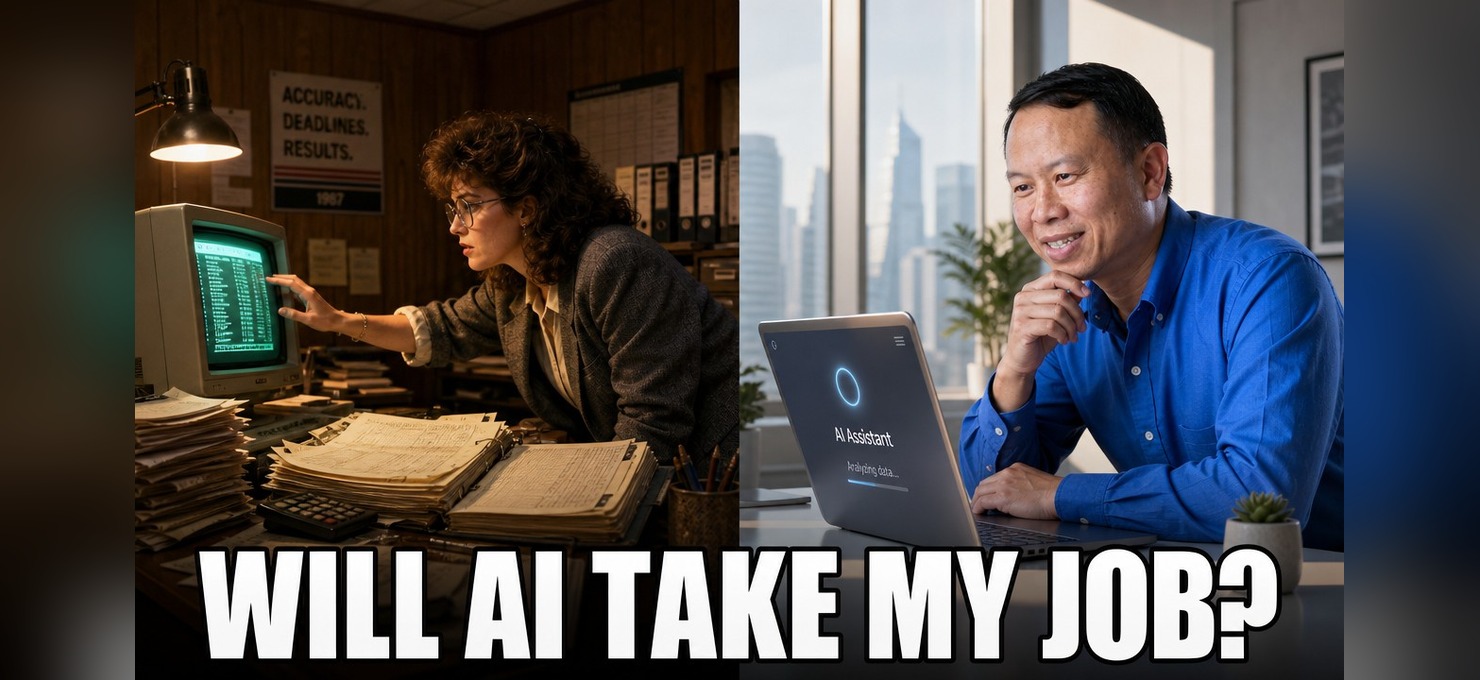
Picture an accountant. Call her Denise.
It is 1985, the last Thursday of the month, and Denise is not going home tonight. The books close tomorrow. On the corner of her desk sits a machine her boss had delivered that afternoon, with a new program on it called Excel. Her boss says it closes the books in an afternoon.
Denise has a ledger open in front of her, a 10-key calculator with the paper tape curling off the edge of the desk and onto the floor, and a pot of coffee that has to last until morning. She has done this every month for eleven years. Everyone else in the building takes five days to close the books. She takes three. She is not part of the finance team. She is the finance team.
And a machine can do it in an afternoon. Which raises a question she does not want to answer tonight: what are eleven years worth?
She could leave the box closed. Plenty of people did. “I’m faster than anyone, I don’t need this” was a reasonable thing to believe, on the night they believed it.
Denise pulls up a chair.
She types the first column of numbers, hunting for each key. It is slower than the calculator. Much slower.
She types a formula at the bottom of the column. A total appears.
She finds one invoice near the top, one she knows by heart, and changes it.
The total at the bottom changes by itself.
No tape. No re-adding. No starting over.
She changes it back. The total changes back.
She sits there for a long time.
That is the moment. Not the day she got faster. The moment she understood that being fast at adding was never going to be the job again, and that knowing what the numbers meant was about to become the whole job.
So she keeps going. The first month with the machine is slower than her calculator. So is the second. By the third, she is getting somewhere. A few months in, she is the only person in the building who understands both the numbers and the machine. Four years later, she is the CFO.
Excel did not replace Denise. But the person who learned Excel could have.
The question behind the question
I told Denise’s story to open an AI lunch-and-learn for a product company with a few dozen people. They had sent me 16 questions ahead of time, and three of them were the same question in different clothes. Will AI take my job? How do I keep from getting dumb? What is it bad at?
Nobody hears anything else until that one gets answered. So here is the rest of my answer.
The job everyone said would go first
In 2016, Geoffrey Hinton, one of the most respected researchers in the history of AI, said people should stop training radiologists.
The logic was hard to argue with. Radiologists read scans. Reading scans is pattern recognition. Pattern recognition is the thing AI is best at. If any skilled job was going to disappear first, it was that one, and the person saying so was one of the people who built the technology.
In 2025, radiology residency programs offered a record number of positions.
That same year, Hinton said he had spoken too broadly. The job most confidently predicted to vanish was hiring.
Radiologists still argue about why, and the honest answer is that more scans and a shortage of people to read them explain a lot of it. But there is an old idea in economics for the broader pattern. In 1865, William Stanley Jevons noticed that more efficient steam engines did not reduce England’s coal use. They increased it, because cheaper power meant people found far more uses for it. When work gets cheaper, the world tends to want more of it, not less. App developers did not exist as a job in 1985. Neither did most of the roles on an Amazon seller’s org chart.
What does change
None of that means nothing happens to jobs. When closing the books took ten people with calculators and then took two people with spreadsheets, one of two things happened to those two. They learned the tool and did far more than close the books, or the company only needed two.
Someone in the room made the competitive version of the point before I could: if a competitor adopts this and their costs drop, you are pricing against a business that runs on fewer hours than yours. AI does not have to take your job for your job to change. Somebody else’s efficiency is enough.
And this one is moving faster than Excel did. METR, an independent research group, measures how long a task an AI agent can finish on its own. From 2019 to 2025 that length doubled roughly every seven months, and in 2024 and 2025 roughly every four. The gap between the people who pulled up the chair and the people who left the box closed widens every few months, not every few years.
Pulling up your chair
Here is the question I gave the team to take back to their desks: what did I do this week that a machine should be doing?
Copying numbers from one system into another. Downloading the same report and reformatting it. Reading a long thread to find one date. Start there. Not the judgment calls, not the relationships, not the decision you get paid to own. The looking, copying, and checking.
And expect to be bad at it. I studied computer engineering, and every time I sat down to write code I fell asleep, so for years I left building to other people. The first things I built with AI were clumsy, and some of them broke in embarrassing ways. That is the price of the chair. You pay it in the first month, and it is cheap.
Nobody remembers how fast Denise could add. They remember that on the worst night of the month, with eleven years on the line, she was the one who pulled up the chair.